
✅ The Unchecked Yes
how impulsive commitment sabotages consistency


this image reminds me of lighter days
A few weeks ago I reached out to a friend letting him know I’d be coming to Pittsburgh soon.
Since he’s someone I don’t get to see frequently enough and lives only a few hours away I invited him to meet me there.
He immediately said YES! THIS WILL BE FUN.
And plans were made…
Or were they?
We’ve all been there.
In fact we’ve touched upon this before.
Someone throws out an exciting opportunity and, before we've had a chance to really think it through—>our time, our energy, our already packed schedules, we blurt out, Yes!
Maybe it’s a volunteer opportunity, hosting an event, or saying yes to Carla barging in on our life-routine.
In the moment it feels right. We’re enthusiastic, engaged, open to possibility!
Often quick yeses! become the very things that sabotage the consistency we’re trying to build.
They pile onto our already full plates, disrupt our carefully crafted routines, and, worst of all, erode the trust we have in ourselves to follow through on what truly matters.
(reread that last part a few times)
Here’s the thing: saying yes feels good. We WANT to do what we are yesing to and we believe saying YES makes us seem agreeable, ambitious, and capable.
We don’t want to disappoint others, and we certainly don’t want to close ourselves off to new possibilities. Sometimes we say yes out of FOMO. Other times, it’s because we momentarily believe we have more time, energy, or bandwidth than we actually do.
The problem is a life of consistency isn’t built on fleeting emotions: it’s built on intention. And, when we say yes without aligning the yes with our priorities, we set ourselves up for failure. Failing not because we’re incapable, but because we’re spreading ourselves too thin.
3 ways YES! Disrupts, Overloads & Weakens:
👍 Overcommitting = Underperforming
When we commit to too many things, something has to give.
The deep work we planned to focus on? Interrupted. The self-care we swore we’d prioritize? Pushed aside. Our best-laid plans unravel because we keep inserting new variables into an already complex equation.
Consistency thrives in simplicity. The more we add, the more we dilute our ability to show up with full commitment to anything.
👍 Overcommitting = Decision Fatigue
Every yes we give means a future decision to either follow through or back out.
And, when we realize we’ve overcommitted, we waste energy agonizing over how to manage it all. Do we cancel? Reschedule? Power through at the expense of something else?
Each unnecessary yes adds weight to our mental load. And that weight makes it harder to stay consistent with what actually matters.
👍 Overcommitting = Weakened Self-Trust
One of the most damaging effects of saying yes too readily is that it erodes our self-trust. Or, to put in dating parlance: we begin to not trust our picker.
We start noticing a pattern:
👉 Commit impulsively.
👉 Struggle to follow through.
👉 Feel overwhelmed or resentful.
👉 Push ourselves to exhaustion or let things slip through the cracks.
Over time, as a result of this patten, we stop believing our own promises.
We hesitate to set new goals because we no longer trust ourselves to meet them.
Consistency isn’t just about habits; it’s about identity.
When our yeses lead to inconsistency, we lose sight of who we aspire to be or how we already want to define ourselves.
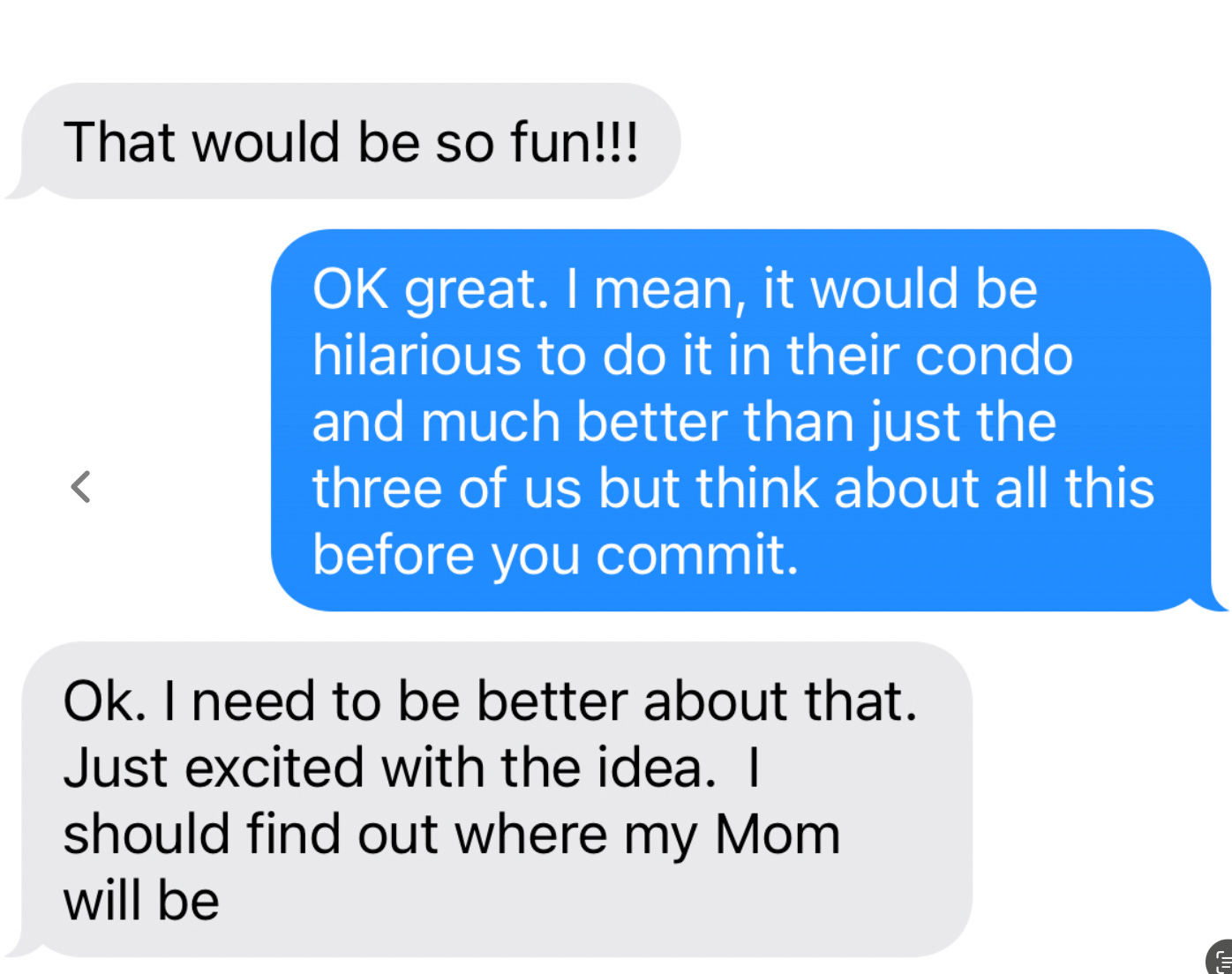
The spontaneous invitation story I shared gave way to a conversation that sparked a moment of intentional decision-making.
My friend rescinded the reflexive YES (which I applauded, I *do* love me some boundaries) and considered the deeper implications of the commitment.
The significance lies not in whether we ultimately met, but in a new, deliberate approach to saying yes. My friend employed a critical questioning technique that transforms decision-making:
What will my yes displace?
Instead of being swept up by excitement, he evaluated how a new commitment intersected with his existing priorities.
By asking ourselves:
What will this yes displace?
Would I still say yes if I had to do it tomorrow?
We reclaim agency over time and energy.
Consistency isn't built on what we say yes to, it's built on what we choose to protect.
The next time you feel the impulse to say yes, remember: the right yes at the right time is powerful. But an unchecked yes is the enemy of the consistent life we are trying to build.
A great piece indeed! I completely agree with the thoughts and reflections by Carla here.
One thing with unchecked yeses is that often the quality of the deliverables is watered down. I mean "the touch and go" kind of output which does not only erode self trust but also erodes the self confidence and ability to give it your all. That moment when you are constantly rushing to execute tasks and becomes sort of a last minute person who is inconsistent.
Perhaps the next article should be on "how to say No". I struggled with this in the past years, thankfully I got to a point where I became very intentional about my goals and priorities. After crafting these, I became clear on where I wanted to be and at what time. I knew where I wanted to have a mastery of skills. It is certainly not a walk in the park but self strategizing, commitment with regular reviews snd evaluations. I am steadily getting there.
Every 'yes' has a price. As does every 'no.' I'm learning as I go along. One of the most valuable lessons I've learned in my 'say yes' life is that I originally adopted the practice as a reaction to my late husband's default of 'no.' The first year after he died I was all in on everything. The second year, still in, but not for everything (often because I didn't want to overcommit.) This year I'm being consciously judicious.
Tangential to the topic: I'm reading 'The Reading List.' A widower in the story reflects that the second year after his wife died is the first year he began and ended a year without her. I really FELT that. 2024 was that year for me.